
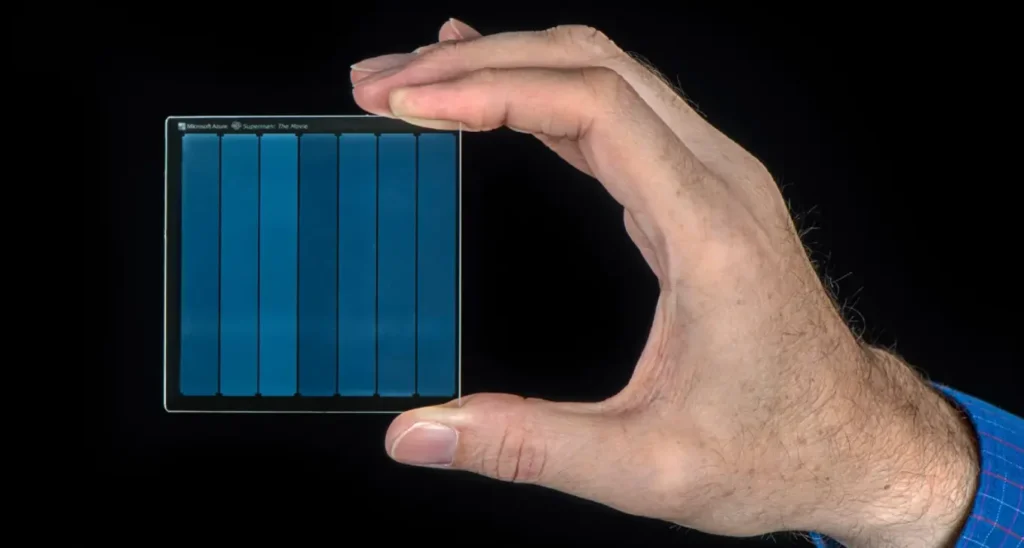
Humans have preserved information on clay tablets, paper, and magnetic disks. Microsoft is proposing a new archival medium that could redefine long term digital storage: a glass chip capable of storing terabytes of data for up to 10,000 years under theoretical conditions.
The initiative, known as Project Silica, uses ultrafast femtosecond lasers to modify glass. Instead of magnetic recording, as used in hard drives and tape, data is engraved within three dimensional layers of borosilicate glass, the same material commonly used in heat resistant cookware.
Data is preserved as precise physical changes inside the material rather than as a surface level magnetic state. This makes it theoretically resistant to gradual degradation and immune to software based tampering that can affect conventional digital storage media.
Technically, Silica relies on what is known as a phase voxel. Data is recorded through variations in the phase of light within three dimensional points inside the glass. Each laser pulse encodes a unit of data, allowing hundreds of layers to be stacked within a single chip approximately 2 millimeters thick.
In experiments published in Nature, researchers recorded 301 layers. The theoretical capacity of a single glass chip reaches 4.8 terabytes. This is equivalent to storing roughly 2,000,000 printed books or thousands of ultra high definition films on a small piece of glass that fits in the palm of a hand.
The central objective of Project Silica is not only storage capacity but what developers describe as benign neglect. The medium can be placed on a shelf without requiring power or continuous maintenance. Modern data centers depend on constant cooling and high electricity consumption. A passive storage layer capable of lasting thousands of years represents a shift in data management philosophy.
Microsoft is targeting institutions such as national archives, museums, and major production studios. These organizations manage high value content that must be protected against technological obsolescence and cybersecurity threats.
Global data volumes continue to expand rapidly. Magnetic tape remains a lower cost option for long term archiving but requires periodic replacement. Hard drives degrade more quickly. Demand for data centers has intensified due to artificial intelligence workloads and cloud services, increasing pressure on conventional storage infrastructure.
Optical storage technologies such as Silica are positioned not as replacements for cloud systems in daily operations but as deeper cold storage layers designed for preservation over decades or centuries without human intervention.
According to the development team, most scientific barriers have been addressed. The remaining challenge lies in industrial scalability. Femtosecond laser systems must operate at higher speeds and lower cost. The use of multiple laser beams and closed loop feedback systems indicates a pathway toward commercial production rather than remaining a laboratory experiment.