
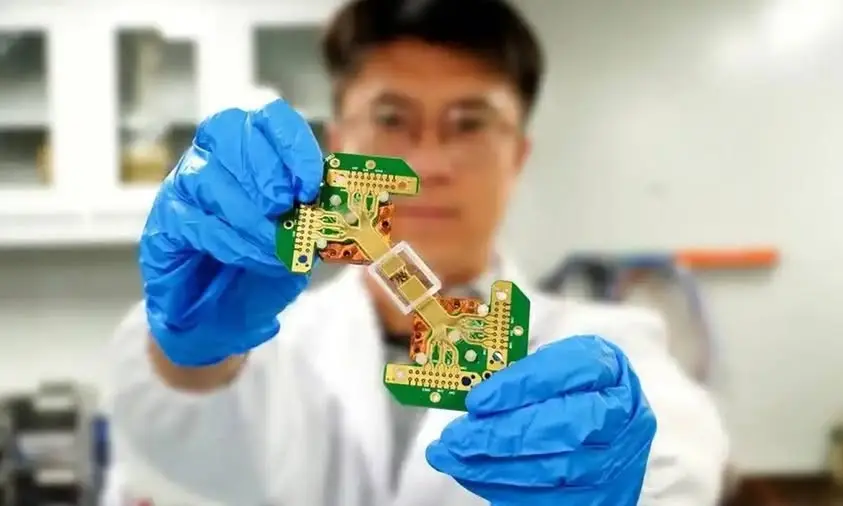
To achieve large-scale quantum communication, chip-based integration is a key direction. After more than six years of technological development, Professor Wang Jianwei, Gong Qihuang, and researcher Chang Lin from Peking University successfully developed two core quantum communication chips, constructing the world’s first large-scale quantum key distribution (QKD) network based on integrated photonic quantum chips, named the “Weiming Quantum Chip Network.” According to Science and Technology Daily, the related research paper was published on May 12, 2025, in Nature.
Twin-Field Quantum Key Distribution (TF-QKD) combines measurement-device-independent security with ultra-long-distance transmission capabilities. Chinese scientists have already achieved point-to-point key distribution over fiber optic distances of thousands of kilometers. However, implementing TF-QKD depends heavily on stable single-photon interference between remote independent laser sources, requiring extremely precise suppression of source noise and high-precision global phase locking and tracking. Existing experiments are mostly based on bulk or discrete fiber-optic components, and most systems serve only two users in a point-to-point configuration.
Quantum key distribution chips (QKD chips) are one of the important pathways toward miniaturized quantum communication systems, practical devices, and scalable networks. The research team developed two chips:
Based on this, the team constructed the Weiming Quantum Chip Network. The network addresses previous limitations in quantum communication, such as few users, limited distance, and complex equipment, and can now support 20 chip-based users communicating simultaneously. Communication between any two users can reach 370 kilometers (370 km / 230 miles), breaking the technical limit of non-repeater communication, with a networked capacity of 3,700 kilometers (3,700 km / 2,299 miles). This achievement enables multi-user, long-distance quantum communication, marking a major step toward practical, large-scale quantum networks, with technical metrics reaching internationally leading standards.
Notably, the team’s photonic quantum chips exhibit high uniformity and yield in wafer-scale fabrication, offering the potential for low-cost mass production, which is critical for building large-scale quantum communication networks.
Reviewers from Nature described this work as a major breakthrough in quantum chip and quantum network research, highlighting the significant scalability of the demonstrated quantum chip network and its expected impact on the field of quantum communication.
According to Professor Wang Jianwei, this is the first demonstration in more than 20 years internationally of a quantum key distribution network based on photonic quantum chips. The team plans to continue research integrating quantum communication chip networks with quantum computing chips, laying the foundation for an integrated and practical quantum information technology system.
Source: Zhang Gailun, Science and Technology Daily