
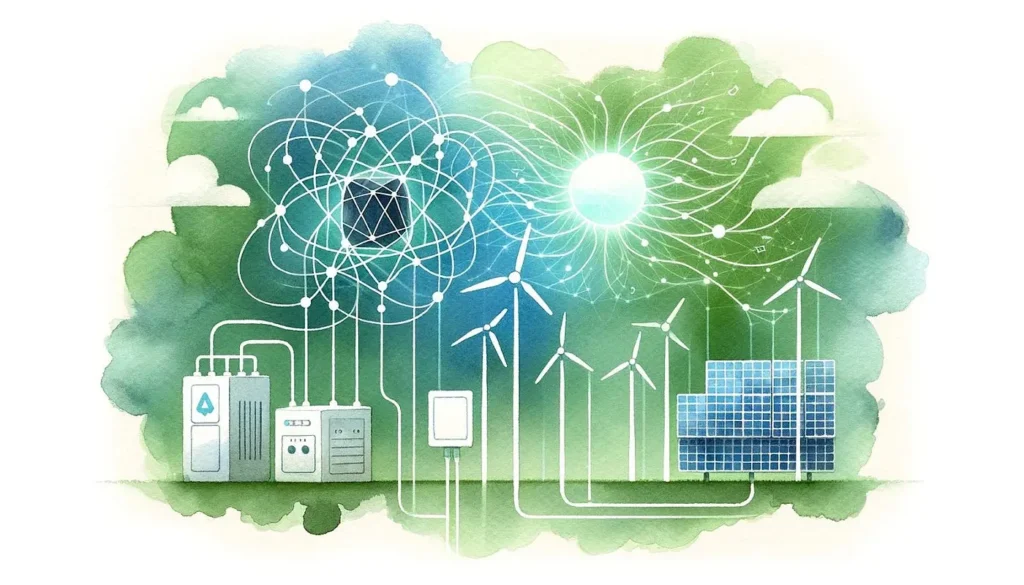
Future city grids will rely on renewable energy generation, but wind and solar power are volatile and uncertain. Quantum computers can find optimal solutions for electricity management. Image source: Physicists.org
At the end of last year, IBM launched two new quantum computers, “Hummingbird” and “Condor”. Meanwhile, Denmark announced plans to build the “world’s most powerful commercial quantum computer.” These developments mark the latest progress in taking quantum technology from the laboratory into the real world.
Quantum technology is rooted in quantum mechanics. Once considered arcane theory, quantum phenomena have become engines of innovation, giving rise to computers that process information in fundamentally new ways, sensors that measure the world with unprecedented precision, and communication networks that are nearly unbreakable.
Infinite possibilities exist at the smallest scales. Today, quantum technology is quietly infiltrating industry, security, and even many aspects of daily life. The Australian magazine The Conversation recently highlighted five ways quantum technology is poised to profoundly impact human daily life.
A pharmacist faces tens of thousands of molecular combinations in search of cures for terminal illnesses; a materials scientist tests countless atomic ratios to produce lighter and stronger battery alloys. While traditional supercomputers can screen these possibilities, they face inherent limitations.
Quantum computers now take center stage. Unlike classical bits, which are either 0 or 1, quantum bits (qubits) can exist in states 0, 1, or a superposition of both—like “Schrödinger’s cat,” alive and dead simultaneously. This allows quantum computers to explore massive numbers of possibilities in parallel, uncovering patterns unreachable by classical systems.
In pharmaceuticals, this enables faster drug discovery and more rapid epidemic response. In materials science, it promises the creation of high-efficiency energy materials, ultra-strong catalysts, and revolutionary polymers. Quantum simulation thus serves as a key tool for unlocking future innovation.
Although fully functional quantum computers are still in development, hybrid “quantum + classical” approaches are already showing promising results.
Quantum sensors, leveraging quantum superposition and entanglement, can detect changes so subtle they are nearly imperceptible, such as minor fluctuations in the Earth’s magnetic field, gravitational variations, or pollutants at one part per hundred million in the air.
In navigation, these sensors require no GPS. Using only subtle differences in Earth’s magnetic and gravitational fields, they can guide submarines deep underwater or aircraft through clouds, achieving true strategic precision.
In medicine, quantum imaging could noninvasively capture brain nerve activity and early tumor signals, improving diagnostic capability and revealing disease causes.
In environmental monitoring, these sensors can track subtle subsurface changes, provide early warning for earthquakes, and detect trace contaminants in air and water with exceptional precision.
Modern society is a vast network: power grid scheduling, flight planning, logistics distribution, financial transactions—each decision affects the whole system. Even the most powerful supercomputers can struggle when facing billions of combinations.
Quantum algorithms, however, can quickly pinpoint optimal solutions by leveraging quantum parallelism.
In the future, quantum technology will enable logistics companies to adjust routes in real time, avoiding congestion and weather delays; airlines to automatically restructure flight schedules, preventing chain delays; energy systems to precisely balance wind and solar fluctuations with peak demand; and financial institutions to simulate multiple market scenarios in parallel.
Cybersecurity is vital to national stability and public welfare. Existing encryption systems face potential “dimensional reduction attacks” from quantum computers, which could compromise internet security.
Yet quantum technology also offers solutions. Quantum communication, especially Quantum Key Distribution (QKD), provides intrinsically secure communication: any eavesdropping disturbs the quantum state and immediately reveals the intrusion.
Quantum encryption can secure financial transactions, personal health records, government secrets, and personal privacy. For national security agencies, it is a strategic priority. For the public, it means more reliable authentication and lower risk of online fraud.
Artificial intelligence (AI) is reshaping the world but is limited by computational power. Training large AI models is time- and energy-intensive, and processing complex systems remains challenging.
Quantum computing may break these barriers. By accelerating machine learning, optimizing neural network architectures, and simulating complex systems, it could allow AI to understand deeper context and handle massive datasets.
Imagine a voice assistant that does not respond mechanically but understands you intuitively; medical AI that integrates genomic and environmental data to customize treatment; and scientific research accelerated through quantum simulation. Quantum technology empowering AI could represent a critical leap in the era of intelligence.
Quantum technology is no longer theoretical. Tens of billions of dollars have been invested globally, with countries competing to develop it. Laboratory prototypes are being tested in real-world conditions. Governments view it as a strategic high ground, and companies see it as a competitive weapon. Its impact extends far beyond technology, potentially reshaping education, labor, infrastructure, and governance.
Source: Science and Technology Daily